
What Is a Mood Board and How to Make One for Your Brand
By Chloe Leonard, Founder of CL Studio
Before I design a single thing for a client, I build a mood board.
It's not optional. It's not just a pretty Pinterest collection. It's a strategic tool, and understanding how to use it can save you thousands of dollars in design revisions.

Mood board for our medicare specialist client, Justin Kendter
What Is a Brand Mood Board?
A mood board is a visual collage that captures the aesthetic direction for your brand. It includes colors, typography, photography styles, textures, patterns, and design references that together communicate the feeling your brand should evoke.
It's less about showing exactly what your brand will look like and more about establishing the creative direction before any actual design begins.
Why Mood Boards Matter
The number one reason design projects go sideways is misaligned expectations. The client is imagining one thing; the designer creates something completely different. Both parties are frustrated, and revisions pile up.
A mood board aligns everyone before the expensive work starts. It answers the question: does this feel like the brand we're trying to build?
Getting a 'yes' on the mood board means the design work that follows is grounded in a shared vision. Getting a 'this isn't quite right' saves you from a complete rebrand in the middle of the process.
What to Include in a Brand Mood Board
Color Palette References
Pull colors that reflect the feeling you want. Not your exact final palette, you'll refine that in the design phase, but the general territory. Warm terracottas or cool blues? Deep jewel tones or soft neutrals?
Typography Inspiration
Serif or sans-serif? Classic or modern? Editorial or approachable? Pull examples of fonts that feel aligned with the brand personality, even if you won't use those exact fonts.
Photography Style
This is often the most telling element. Bright and airy or moody and dramatic? Lifestyle photography or product-focused? Natural textures or clean studio shots? The photography you're drawn to says a lot about the brand you want to build.
Textures and Patterns
Linen, marble, grain, concrete, textures communicate a lot about brand personality. Soft and organic or structured and precise? Personally, I love some texture, it adds depth and keeps brands from feeling too flat and digital.
Design Style References
Pull brand identities, packaging, websites, or print materials that feel aligned with where you're going. You're not copying them, you're showing the aesthetic territory you're working in.
How to Build a Brand Mood Board
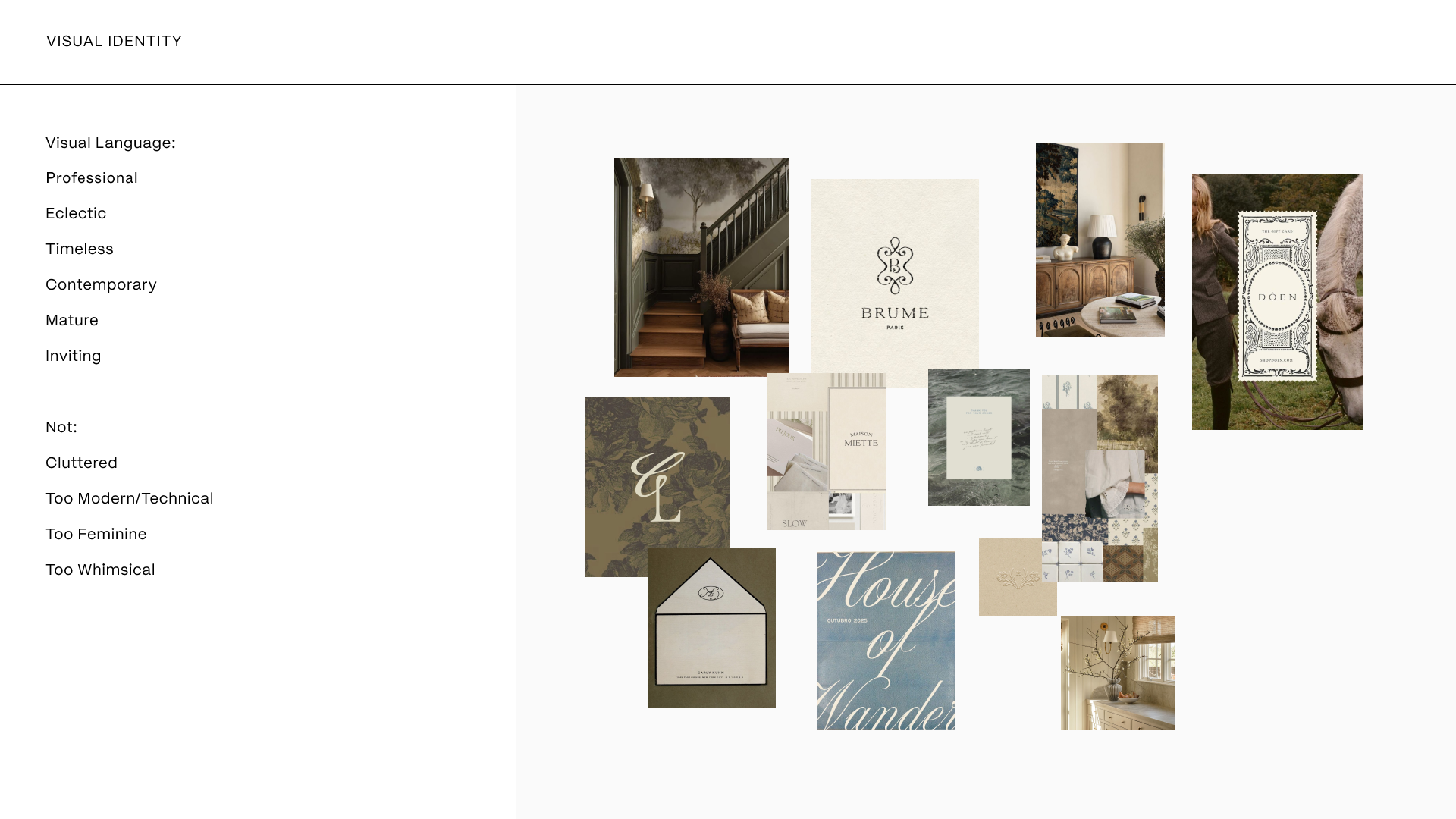
Mood board for our Charleston Interior Designer client, Claudia Leonard Interiors.
Start with your brand personality. Before you collect any images, write down 3–5 adjectives that describe how you want your brand to feel. Refined. Warm. Confident. Minimal. Elevated. These guide every image you pull.
Collect references from multiple sources. Pinterest is the obvious one, but also pull from Behance, Instagram, design blogs, and even editorial photography. Cast a wide net, then edit down ruthlessly.
Edit for cohesion. A good mood board feels unified. If you have 30 images and they're pulling in 10 different directions, keep editing. You're looking for the images that feel like they belong together.
Arrange intentionally. The layout of a mood board matters. Images should be sized and arranged so the overall composition feels balanced and cohesive, not just dropped on a page.
Common Mood Board Mistakes
Collecting too many images without editing. More is not better. A focused mood board of 12 images tells a clearer story than 50.
Mixing too many different aesthetic directions. If half your board is minimal and modern and the other half is eclectic and maximalist, you haven't made a decision yet.
Confusing inspiration with imitation. A mood board should capture a feeling, not be a blueprint to copy.
Ready to Build a Brand That Feels Like You, Intentionally?
At CL Studio, the mood board is step one of every branding project. It sets the creative direction so every design decision that follows is intentional, which is why we approach every project as a brand design agency for small business, not just a design service. If you’re ready to build a brand with real strategy behind it, let’s talk.

Hi there! I'm so glad you found us in this corner of the internet.
I'm Chloe Leonard, the founder of CL Studio, a boutique creative agency based in Nashville, TN. After 10 years of working with hundreds of clients, including Almost 30 Podcast, Clearstem Skincare, Harper Collins, and Free People, I've become more passionate than ever about giving founders the clarity and tools to build brands that TRULY stand out.
We help service-based and eCommerce businesses move from DIY beginnings to fully-realized. brands – built with confidence and longevity in mind. Because good brands show up, but great brands own the room for years to come.
DOWNLOAD THE FREE BRAND AUDIT GUIDE
Feel like your brand is missing the mark? Not sure where to start?
As a creative agency for small business for almost a decade, we know where a brand needs a little TLC. That’s why we created a free brand audit guide so you can finally see your brand clearly, and know exactly what to fix.
